

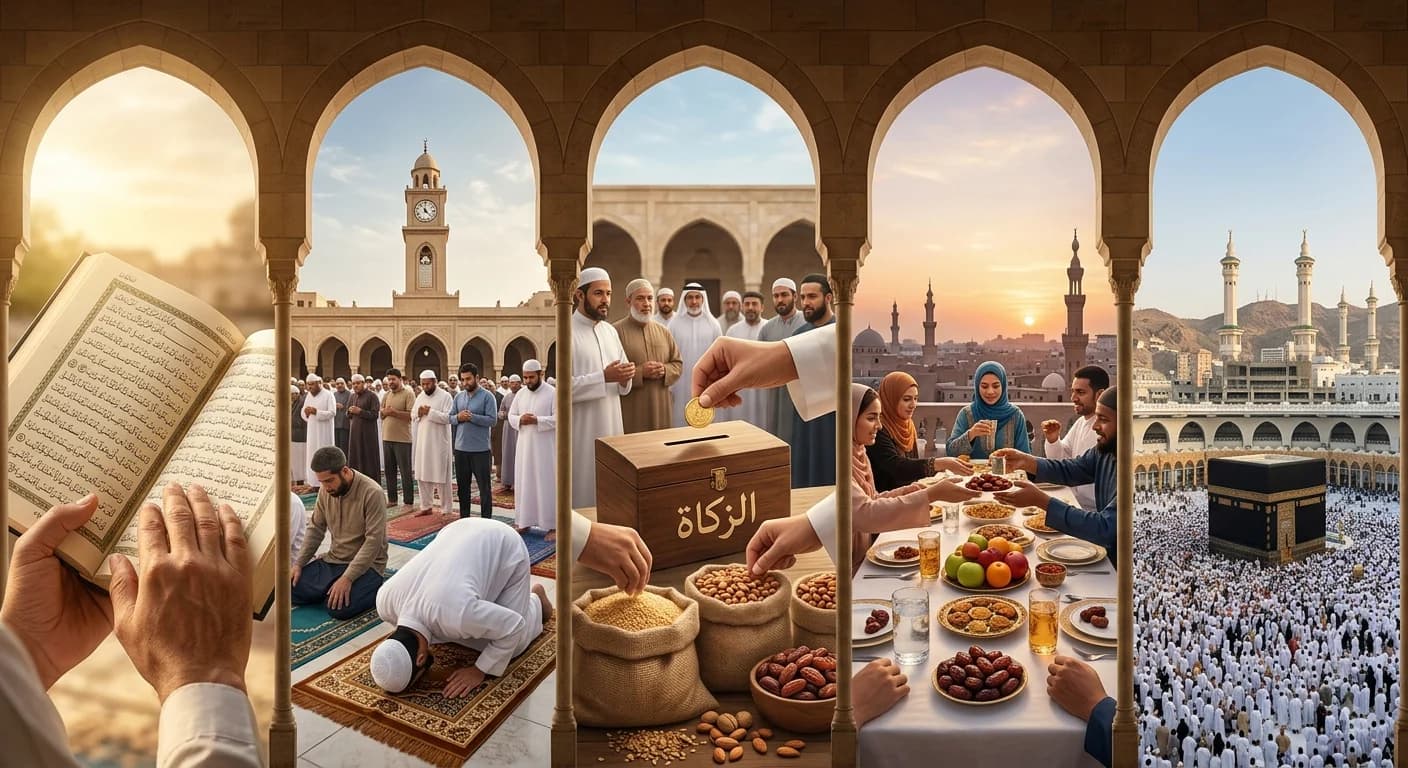
What Are the 5 Pillars of Islam? Their Meaning, Evidence and Wisdom
A Muslim's religious life rests on five foundations: pronouncing the Shahada, praying five times a day, giving zakat, fasting in Ramadan, and — for those with the means — performing the Hajj. These are not five separate duties standing side by side; they are the load-bearing columns that hold faith upright and give a believer a whole way of living.
The framework comes from the Hadith of Jibril. Asked what Islam is, the Prophet Muhammad (peace be upon him) named the five conditions one by one, and what emerges from them is a single structure governing both the servant's bond with his Lord and his place among people. Each pillar below is set out through its definition, the evidence it rests on, its ruling, and the wisdom behind it.
1. The Shahada: The First Step Into Islam
The word shahada means to bear witness, to affirm, to accept. That is precisely what the declaration does: it puts into words the affirmation already held in the heart. No one enters the fold of Islam without pronouncing it, which makes the Shahada not merely the first condition but the ground on which the four that follow are built.
أَشْهَدُ أَنْ لَا إِلٰهَ إِلَّا اللهُ وَأَشْهَدُ أَنَّ مُحَمَّدًا عَبْدُهُ وَرَسُولُهُ
Ashhadu an la ilaha illallah wa ashhadu anna Muhammadan abduhu wa rasuluhu.
“I bear witness that there is no god but Allah, and I bear witness that Muhammad is His servant and His Messenger.”
Two affirmations sit inside that one sentence: the existence and oneness of Allah, and the standing of Muhammad (peace be upon him) as His servant and final prophet. In the Hadith of Jibril the Prophet named bearing witness to both as the first condition of Islam. As for its wisdom, the Shahada clears the heart of every form of polytheism and turns it toward the Creator alone; it is also where a Muslim's sense of identity and belonging begins.
2. Prayer: The Pillar of the Faith and the Servant's Meeting With His Lord
Prayer is a bodily act of worship, obligatory five times a day upon every Muslim of sound mind who has reached puberty. It is performed at set times, facing the Qibla, through pillars such as standing, bowing and prostration. The Qur'an stresses its weight in many verses:
وَاَق۪يمُوا الصَّلٰوةَ وَاٰتُوا الزَّكٰوةَ
Wa aqimu al-salata wa atu al-zakata.
“Perform the prayer properly and give zakat.” (al-Baqarah, 2:43)
That prayer is obligatory is established by the Qur'an, the Sunnah and scholarly consensus. Abandoning it deliberately out of laziness counts among the major sins; a person who does not deny its obligation, however, remains a Muslim.
The Five Prayer Times of the Day
- Fajr: from true dawn until sunrise.
- Dhuhr: begins once the sun passes its zenith and lasts until the Asr time enters.
- Asr: from the point at which shadows reach a set proportion until sunset.
- Maghrib: begins shortly after sunset and continues until the twilight disappears.
- Isha: enters with the disappearance of the twilight and extends until the time of imsak.
The wisdom of prayer lies in drawing the servant nearer to Allah, disciplining the soul and holding a person back from wrongdoing. Standing before Allah five times a day guards character, trains the self, and keeps a steady awareness running through ordinary life.
3. Zakat: The Act of Worship That Purifies Wealth
Zakat is the financial act of worship through which Islam builds social solidarity and economic balance. The word literally means to purify, to increase, to cleanse. In practice it means that a Muslim whose wealth reaches the nisab threshold — roughly 80.14 grams of gold or its equivalent — gives one fortieth of it, 2.5 per cent, to those in need according to the established rules.
خُذْ مِنْ اَمْوَالِهِمْ صَدَقَةً تُطَهِّرُهُمْ وَتُزَكّ۪يهِمْ بِهَا
Khudh min amwalihim sadaqatan tutahhiruhum wa tuzakkihim biha.
“Take zakat from their wealth so that you may purify and cleanse them.” (al-Tawbah, 9:103)
The Eight Categories Entitled to Zakat
Who may receive zakat is named plainly in the Qur'an (al-Tawbah, 9:60):
- The poor
- The destitute
- Those appointed to collect zakat
- Those whose hearts are being won over to Islam
- Those to be freed from bondage
- Those burdened by debt
- Those in the way of Allah
- The wayfarer left stranded
The wisdom of zakat runs in more than one direction: it clears the wealthy of miserliness, brings blessing to wealth, looks after the poor and strengthens brotherhood across social classes. Wealth is kept from piling up in a few hands, and production, circulation and solidarity are supported together. Our zakat calculator works out what you owe.
4. Fasting: Training the Will, Disciplining the Self
Fasting means abstaining from food, drink and sexual relations from the time of imsak until sunset through the month of Ramadan, with the intention of worship. It is obligatory upon every Muslim who is of sound mind, in good health and resident.
فَمَنْ شَهِدَ مِنْكُمُ الشَّهْرَ فَلْيَصُمْهُ
Faman shahida minkum al-shahra falyasumhu.
“Whoever among you witnesses the month of Ramadan should fast.” (al-Baqarah, 2:185)
Circumstances That Permit Not Fasting
- Serious illness, or a risk that fasting would harm one's health
- A journey considered lawful under Islamic law
- Pregnancy and breastfeeding
- Advanced age and a frailty that makes fasting impossible
- Menstruation and the postpartum period
Fasts missed for these reasons are made up once the reason falls away; where the condition is permanent, as with old age, they are compensated through fidyah. Missing a Ramadan fast with no valid reason is a major sin and may require both making it up and paying expiation.
The wisdom of fasting gathers around patience: a person comes to understand the state of the poor by living it, notices the worth of what he has, and learns to rein in his appetites. The Prophet (peace be upon him) described fasting as a shield against evil and against the Fire.
5. Hajj: The Sacred Journey Made Once in a Lifetime
Hajj is obligatory once in a lifetime upon every Muslim whose means and health allow it. Entering ihram within a set period, standing at Arafat, and visiting the Kaaba to perform the tawaf are its fundamental pillars.
وَلِلهِ عَلَى النَّاسِ حِجُّ الْبَيْتِ مَنِ اسْتَطَاعَ اِلَيْهِ سَب۪يلاً
Wa lillahi ala al-nasi hijju al-bayti mani istata'a ilayhi sabila.
“It is a duty owed to Allah by those who are able to make the pilgrimage to the House.” (Al Imran, 3:97)
The wisdom of Hajj is that it gathers Muslims from every corner of the world in one time and one place, erasing differences of race, language, colour and social standing. The ihram reminds a person of the Day of Gathering and of how briefly this world lasts; every pillar of the Hajj reinforces the consciousness of tawhid.
What the Five Pillars Achieve Together
Read one at a time, the five pillars look like separate acts of worship; read together, they form a whole. The Shahada lays the foundation of faith, prayer keeps the heart tied to Allah through the day, fasting disciplines the self, zakat purifies wealth and secures social justice, and Hajj is the summit where all of these virtues meet at the scale of the whole community. Each one orders both the servant's relationship with his Lord and his dealings with the people around him.
That harmony between the acts of worship shapes a Muslim's way of life as a single piece: it strengthens individual character while feeding the peace of the society he lives in. Where Qurbani fits within that whole is set out in What Is Qurbani?, and the blessed days and nights of the worship calendar in our Kandil Nights guide.
Sources
- The Qur'an: al-Baqarah 2:43, 2:185; Al Imran 3:97; al-Tawbah 9:60, 9:103.
- Hadith: Bukhari, Faith, 1-2; Muslim, Faith, 1 (the Hadith of Jibril); Muslim, Hajj, 412.
Frequently asked questions
Ready to support our projects?
You may also like
 General
What Are the Kandil Nights? The 2026 Calendar of Blessed Days and Their Meanings
The meaning of the five great Kandil nights, the other blessed days, and every 2026 date in one calendar — including Mawlid al-Nabi on 24 August 2026.
 Water Well
Six Hours a Day: The Hidden Cost of Fetching Water for Women and Girls in Africa
Before the sun is fully up, millions of women and girls across Africa are already on the road with an empty jerry can. Here is what a six-hour round trip for water really costs a family.